I don't think I've mentioned how much I love the Relevant website and their magazine. I just read a great thought provoking review of the movie The Nativity Story.
Check out this excerpt from Scot McKnight's review.
"I have a claim I ask you to consider. Here it is: I claim the first Christmas, the one experienced by Mary and Joseph, was a Magnificat Christmas. The Magnificat, Mary’s famous song that begins, “My soul glorifies the Lord and my spirit rejoices in God my Savior” (Luke 1:46-47, TNIV), expresses the yearning of the pious poor for God’s redemptive justice and for the day when the world will be put to rights. The themes of the Magnificat, which express what Mary thinks God is doing in her son, are ending injustice and establishing justice, bringing peace and ending poverty. Those are the themes of a Magnificat Christmas."
Another voice calling us to see the clear themes of the first Christmas. How have we drifted so far from these themes in our celebration of Christmas? I'm reminded of something Rick Warren said when describing his aha moment: "How did I miss the one thousand verses about the poor?!"
Read the entire review here.
Showing posts with label justice. Show all posts
Showing posts with label justice. Show all posts
Friday, December 01, 2006


Thursday, November 30, 2006
The Advent Experiment
So the Advent experiment that Imago Dei and four other churches are engaging in is this: What if we took what we normally spend on Christmas gifts and instead give it away to those who need it most? What if we gave oursleves relationally to our loved ones, as Jesus gave himself relationally to us, rather than give each other material gifts that we don't even remember the following the year?
You can already hear the "devil's advocates" (more on that term later) saying, "But the wise men gave gifts!"
Yes. To JESUS! Not to each other. In his sermon Rick McKinley illustrates the re-imagined magi scene like this:
(First wise man) "Oh look at the baby." (Pause. Turn to Bill.) "Bill, here's some frankincense for you."
(Second wise man, aka Bill) "Oh thank you, my wife will love this. And here's some mirh for you."
People make things.
Other people convince us we need them.
We buy them.
"That's how the empire works," says McKinley.
McKinely goes on to say, "We can almost hear the economists responding to this crazy idea with, 'Well that won’t be very good for the empire.'
And if we actually take our faith seriously and start redistributing our wealth instead of buying junk for each other, we might hear the economists say, 'We should probably get rid of the baby and keep Santa, that would be better for the empire.'”
Giving and receiving IS part of the advent story. God is giving himself and we are receiving. We don’t serve a God who just gives us stuff. He's not like one of those busy, detached dads who doesn't have a relationship with his kids so he gives them a big check at Christmas to try to make up for it.
This experiment isn't about not giving gifts. It's about trying to immitate Christ by giving ourselves as gifts to others. It's about learning how to do this. It's about trying to point to the Christmas story in the way that we give.
The average American spends $300 – $1100 on Christmas presents each year. Imago Dei and the four other churches that are partnering together have figured out that if two-thirds of their congregations take on this experiment (based on the low end of the average mentioned above) they would collect 1 million dollars! 1 million dollars of our wealth to redistribute to those who need it most. (Click here to see where the $1 million will go.)
And this is only 5 churches! What if every church participated in this experiment? What if we all decided that this just might be a gift that would bless and honor the Baby more than giving stuff to each other?
(Most of this post was taken from notes from Rick McKinley's Advent sermon.)
You can already hear the "devil's advocates" (more on that term later) saying, "But the wise men gave gifts!"
Yes. To JESUS! Not to each other. In his sermon Rick McKinley illustrates the re-imagined magi scene like this:
(First wise man) "Oh look at the baby." (Pause. Turn to Bill.) "Bill, here's some frankincense for you."
(Second wise man, aka Bill) "Oh thank you, my wife will love this. And here's some mirh for you."
People make things.
Other people convince us we need them.
We buy them.
"That's how the empire works," says McKinley.
McKinely goes on to say, "We can almost hear the economists responding to this crazy idea with, 'Well that won’t be very good for the empire.'
And if we actually take our faith seriously and start redistributing our wealth instead of buying junk for each other, we might hear the economists say, 'We should probably get rid of the baby and keep Santa, that would be better for the empire.'”
Giving and receiving IS part of the advent story. God is giving himself and we are receiving. We don’t serve a God who just gives us stuff. He's not like one of those busy, detached dads who doesn't have a relationship with his kids so he gives them a big check at Christmas to try to make up for it.
This experiment isn't about not giving gifts. It's about trying to immitate Christ by giving ourselves as gifts to others. It's about learning how to do this. It's about trying to point to the Christmas story in the way that we give.
The average American spends $300 – $1100 on Christmas presents each year. Imago Dei and the four other churches that are partnering together have figured out that if two-thirds of their congregations take on this experiment (based on the low end of the average mentioned above) they would collect 1 million dollars! 1 million dollars of our wealth to redistribute to those who need it most. (Click here to see where the $1 million will go.)
And this is only 5 churches! What if every church participated in this experiment? What if we all decided that this just might be a gift that would bless and honor the Baby more than giving stuff to each other?
(Most of this post was taken from notes from Rick McKinley's Advent sermon.)
More on the "Vision of Advent"
I took notes on the sermon I mentioned in my previous post and wanted to share some of them.
An underlying theme of the sermon is that a defining characteristic and call to Christ-followers (ie. "the Church") is to live prophetically in a culture, which sometimes means critiquing it.
When Jesus entered the culture as a poor baby, it caused an upheaval in the society. So much so that the king had all the baby boys two-years-old and under murdered out of fear of this newborn king.
As American followers of Christ we have somehow married our capitalist consumerism culture with Jesus in an attempt to smooth out the tension that exists between the story of Christmas and the values of our culture. But by doing this, we’re missing/changing the Christmas story.
Paul sums up the story of the incarnation in 2 Corinthians 8:9 when he says, “For you know the grace of our Lord Jesus Christ that though he was rich, yet for your sake he became poor so that you through his poverty might become rich.”
The Christmas story is a story of the redistribution of wealth – that Christ who had everything in heaven become impoverished and entered into a world of poverty so that we might enter the blessing and wealth of His life.
Jesus didn't cling to his status or his wealth. He layed it down and gave it away so that the world could be blessed. Does our celebration of Christmas reflect this? Do we who are rich lay down our wealth and give it away so that others can be blessed?
Check out these statistics:
The U.S. spends $7 billion on Halloween
The U.S. spends $450 billion on Christmas
Then we read about the $20 billion that needs to be raised to solve Aids problems and the $100 billion that the UN is trying to come up with to solve the water crisis (lack of clean water is the cause of a huge amount of disease in developing countries) and we think, "How can we ever come up with the money to solve these problems?"
Hmm...any ideas?
An underlying theme of the sermon is that a defining characteristic and call to Christ-followers (ie. "the Church") is to live prophetically in a culture, which sometimes means critiquing it.
When Jesus entered the culture as a poor baby, it caused an upheaval in the society. So much so that the king had all the baby boys two-years-old and under murdered out of fear of this newborn king.
As American followers of Christ we have somehow married our capitalist consumerism culture with Jesus in an attempt to smooth out the tension that exists between the story of Christmas and the values of our culture. But by doing this, we’re missing/changing the Christmas story.
Paul sums up the story of the incarnation in 2 Corinthians 8:9 when he says, “For you know the grace of our Lord Jesus Christ that though he was rich, yet for your sake he became poor so that you through his poverty might become rich.”
The Christmas story is a story of the redistribution of wealth – that Christ who had everything in heaven become impoverished and entered into a world of poverty so that we might enter the blessing and wealth of His life.
Jesus didn't cling to his status or his wealth. He layed it down and gave it away so that the world could be blessed. Does our celebration of Christmas reflect this? Do we who are rich lay down our wealth and give it away so that others can be blessed?
Check out these statistics:
The U.S. spends $7 billion on Halloween
The U.S. spends $450 billion on Christmas
Then we read about the $20 billion that needs to be raised to solve Aids problems and the $100 billion that the UN is trying to come up with to solve the water crisis (lack of clean water is the cause of a huge amount of disease in developing countries) and we think, "How can we ever come up with the money to solve these problems?"
Hmm...any ideas?
"Vision of Advent"
I recently listened to a sermon from a church in Portland called Imago Dei. (You may have heard of this church through Don Miller's books.) I am so challenged by this sermon and their vision of advent that I can't stop thinking about it or talking about it with people. I've copied and pasted the sermon summary from Imago Dei's website below. (I don't think they'll mind.) You can also listen to the sermon here, which I highly recommend. I'll share some more thoughts on this vision in another post.
"The gospel is not bound to any given culture. It is a-cultural. It can enter any specific culture and engage with different redemptive windows of that culture. This is our philosophy of ministry at Imago Dei in a nutshell. However, when the gospel enters a culture, in addition to redeeming aspects of it the gospel also critiques pieces of the culture that are opposed to the values of God’s Kingdom. This is what it means to live a prophetic life. We see this type of critique in the incarnation itself. Herod’s Kingdom (the culture in which Christ literally showed up) was one driven by the values of mass wealth, power of military force, greed, and personal gain. Christ enters this culture through poverty, weakness, dependency, and sacrifice. This is the biblical picture of advent.
How does our current celebration of Christmas reflect this incarnation? That is, does our experience of the advent season match the biblical values of the gospel? What can our advent season look like this year if we intentionally choose to be a prophetic voice in our culture? The last thing we want to do is be obnoxious about it. But if we choose to reflect the Kingdom values in this season, we probably will be looked at funny. Are you willing to be looked at funny this season for the sake of the gospel? Here are three themes we see in the advent of Christ that we would like to pursue as a congregation:
God became poor so that we could be rich.
What are the social implications of this for us? How can we choose not to waste what we have but give it away in ways that meet significant needs of those around us? Can our gift giving feed hunger instead of greed?
God gave himself relationally.
First and foremost we desire to give gifts to each other this season that are relationally driven. We desire to learn what it means to give of ourselves and not just give stuff. We will be resourcing you with many ideas on how to approach this.
When Jesus showed up, people worshipped him.
What would it look like if Jesus was actually the focus of Advent? Can we respond like the shepherds and Magi, who celebrated the first Advent by praising God and worshipping the Son?
When we receive, we receive Jesus, not stuff.
If Jesus became poor that we may be rich, are we truly receiving the riches that he has given us? Are we receiving Him? How do we as a community ultimately embrace Jesus this Advent season and not be distracted by all the hype around us?"
"The gospel is not bound to any given culture. It is a-cultural. It can enter any specific culture and engage with different redemptive windows of that culture. This is our philosophy of ministry at Imago Dei in a nutshell. However, when the gospel enters a culture, in addition to redeeming aspects of it the gospel also critiques pieces of the culture that are opposed to the values of God’s Kingdom. This is what it means to live a prophetic life. We see this type of critique in the incarnation itself. Herod’s Kingdom (the culture in which Christ literally showed up) was one driven by the values of mass wealth, power of military force, greed, and personal gain. Christ enters this culture through poverty, weakness, dependency, and sacrifice. This is the biblical picture of advent.
How does our current celebration of Christmas reflect this incarnation? That is, does our experience of the advent season match the biblical values of the gospel? What can our advent season look like this year if we intentionally choose to be a prophetic voice in our culture? The last thing we want to do is be obnoxious about it. But if we choose to reflect the Kingdom values in this season, we probably will be looked at funny. Are you willing to be looked at funny this season for the sake of the gospel? Here are three themes we see in the advent of Christ that we would like to pursue as a congregation:
God became poor so that we could be rich.
What are the social implications of this for us? How can we choose not to waste what we have but give it away in ways that meet significant needs of those around us? Can our gift giving feed hunger instead of greed?
God gave himself relationally.
First and foremost we desire to give gifts to each other this season that are relationally driven. We desire to learn what it means to give of ourselves and not just give stuff. We will be resourcing you with many ideas on how to approach this.
When Jesus showed up, people worshipped him.
What would it look like if Jesus was actually the focus of Advent? Can we respond like the shepherds and Magi, who celebrated the first Advent by praising God and worshipping the Son?
When we receive, we receive Jesus, not stuff.
If Jesus became poor that we may be rich, are we truly receiving the riches that he has given us? Are we receiving Him? How do we as a community ultimately embrace Jesus this Advent season and not be distracted by all the hype around us?"
Thursday, November 02, 2006
"Women Of Vision"
 Andy and I just heard Renee Stearns, wife of World Vision President Richard Stearns, speak in Lake Grove. It was a "speaker event" for Women of Vision, a volunteer ministry of World Vision that is a "partnership of Christian women who are called to invest their time, intellect, compassion, creativity, and finances to meet the needs of impoverished and oppressed women and children throughout the world."
As of now there are only 13 Women of Vision chapters in the world and one of them is in our backyard, the Columbia-Willamette Chapter. I am excited about this group and wonder if anyone else might get excited too. Check out the links. If you only have time for one, go to the local chapter's website. I'm particularly interested in their Advocacy page and the Contact Your Representatives page.
Seven Ways to Pray in 2007 (from an insert in World Vision Magazine, Winter 2006)
When You
1 Take a shower - pray for clean water
2 Go to work - pray for child laborers
3 Eat lunch - pray for hungry and malnourished children
4 Watch the news - pray for education
5 Arrive home - pray for displaced children
6 Take a vitamin - pray for medical access
7 Go to bed - pray for orphans
"And prayer offered in faith will make the sick person well; the Lord will raise him up. ... The earnest prayer of a righteous person has great power and produces wonderful results." - James 5:15-16
One other great resource that I want to check out is a bible study they've put together called "The Heart of the Matter: Touching the Lives of Women in Poverty."
I think I'll save their "Five Ways You Can Be an Advocate for Children" for another post. If anything in this post tugged at your heart, pray, and then let me know. Let's open ourselves to whatever God has for us.
Monday, August 28, 2006
Meal Time Prayer
I just wrote out this prayer and put it on our table. I found it in Sojourners magazine. My daughter has enjoyed trying to recite it at meal times.
"Lord, to those who hunger, give bread.
And to those who have bread, give the hunger for justice."
- Latin American prayer
I'm still trying to find time to blog again. I'm hoping that after MOPS gets up and running in the next couple of weeks, I'll have more free time to do so.
"Lord, to those who hunger, give bread.
And to those who have bread, give the hunger for justice."
- Latin American prayer
I'm still trying to find time to blog again. I'm hoping that after MOPS gets up and running in the next couple of weeks, I'll have more free time to do so.
Wednesday, May 10, 2006
D.C. Was Amazing!
 Ahhhh, finally time to take a deep breath and write a post. The kids and I are in Phoenix right now with my parents. This is the third of four trips for me this month. May feels like a whirlwind – crazy, but fun.
 Our trip to D.C. was amazing. International Justice Mission’s (IJM) Global Prayer Gathering was awesome! We were so blessed and encouraged to be amongst people who pray with courage and boldness - people who know to whom it is they pray and therefore ask big. After hearing stories and first-hand testimonies of slaves being freed and perpetrators of all kinds of abuse being brought to justice, I experienced a whole new level of worship as we sang songs like “How Great Is Our God.”
Saturday night we prayed by candlelight at the Lincoln Memorial (pictured on previous post), a symbol of freedom for those who were oppressed and enslaved in our own country. Monday, we spent a few hours in the Holocaust Memorial Museum. It was so moving, gut wrenching, and powerful, particularly coming off of the IJM prayer gathering and particularly because in D.C. that weekend there were demonstrations bringing attention to the holocaust that is taking place in Sudan right now. As I read the stories in the museum I was challenged to consider who I would have been if I had been there, and who I am as a player in this chapter of history – Am I a rescuer? Or am I a self-centered, apathetic person who avoids the truth (reality) of what is happening all around me?
There is a poem in the museum that keeps ringing in my heart and mind.

The theme verse for IJM’s Global Prayer Gathering was Psalm 12:5:
“The LORD replies, I have seen violence done to the helpless, and I have heard the groans of the poor. Now I will rise up to rescue them, as they have longed for me to do.”
IJM’s message is, “As the Lord our God rises up to rescue the oppressed, our God calls upon us to be His instruments.”
God is rising up. Am I? Are you?
Thursday, April 27, 2006
We're off to Washington D.C.!

We're heading off to Washington D.C. (without the kids) to attend the Global Prayer Gathering of International Justice Mission. It should be an amazing time of hearing what God is doing around the world to rescue vicitims of injustice.
All of IJM's field offices will be at the gathering to report on their area and to ask for prayer. We will get to pray with many IJM staff and we will get to worship God among them to the tune of approximately 500 voices. I am humbled to get to be among these people who have joined God in his passionate pursuit of justice for the most vulnerable people around the world.
We are flying standby and the flights are really full; some are completely full or overbooked. Would you please pray that we will get to D.C. by Friday, preferably by the afternoon. My friend Nicole said that she has no doubt we'll get there because God wants us there. She also said that if the flights were wide open it wouldn't take any faith. I think she's right. I can't see why God wouldn't want us to be there, so I'm trying to believe that he'll open the way. I'm just hoping he's not more interested in teaching me about patience, releasing control, and relinquishing expectations.
While you're at it, would you pray that we could get home on Sunday or Monday? The flights are just as bad for the return leg. Thanks friends!
Wednesday, April 05, 2006
Give Your Lunch
 Life has been getting in the way of blogging lately, but here's the follow up to my last post. Let me just start by saying that I have a new hero. Gary Haugen, President of International Justice Mission (IJM) is an incredible human being with great hope in our great God. It was an honor to meet him and to hear from his mouth what I believe was a message straight from God’s heart. Here are my “take aways” from the message he delivered entitled The Unfamiliar Passions of God:
• Are Jesus and I passionate about the same things?
• God hates injustice with a fierce passion.
• God desires to bring justice and rescue to the oppressed.
• He has a plan to accomplish this.
• We are the plan.
• (There is no Plan B.)
Gary told the story from John 6 about the loaves and fishes. You know the story. Jesus says to His disciples, “Feed them.” The disciples come back with, “We don’t have enough.” (They are presented with an overwhelming need and they have inadequate resources.)
Disciples: “Back to you Jesus.”
Jesus: “What do you have?”
Disciples present the boy with 5 loaves and 2 fishes.
Andrew: “What are these among so many?”
Jesus: “Give it to me.”*
Most of us believe that there is nothing we can possibly do to bring justice to the millions of victims of oppression around the world. And we are right. That would take a miracle, or many miracles. But that’s not what Jesus is asking us to do. He didn’t ask his disciples or the boy to work a miracle. Jesus took responsibility for the miracle. The disciples and the boy were responsible to simply offer what they had so that Jesus could do the miracle.
Final takeaways:
• Offer what you have (Give Jesus your lunch)
• Jesus will do the miracle.
God is blessing the efforts of International Justice Mission in miraculous ways. This, of course, should not come as a surprise! They are offering their lunches for one of God’s deepest passions. Realizing that God did not have a Plan B, they decided to show up for Plan A.
What can you and I offer to Jesus so that he can fulfill his passion and plan to rescue the oppressed, defend the orphan, and plead for the widow?
*Quoted from the message transcript.
Friday, March 24, 2006
President of International Justice Mission is Speaking in Portland This Sunday
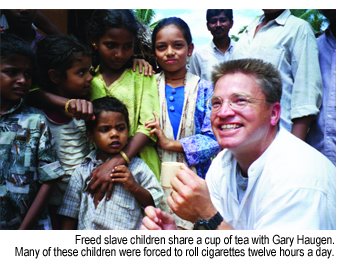
Gary Haugen, President of International Justice Mission, will be speaking at Sunset Presbyterian Church this Sunday, March 26th, at 9 am, 11 am, and 5 pm. Childcare is provided during all three services for infants through preschool.
Andy and I are pumped about hearing him. We're loving reading his book Good News About Injustice. We're going to the 5 pm service. Come! We'll save you a seat. We can all go out to a kid-friendly restaurant afterwards. :-)
Here is an excerpt from Good News About Injustice:
The battle against oppression stands or falls on the battlefield of hope. No one knows this better than the oppressors. They know that they never have enough power, lies or loyalty to withstand the onslaught of even a fraction of the power, truth and courage that humanity could at any minute amass against them. Therefore they rely on, utterly depend on, the inaction of despair. They know full well that their preeminence depends on most people in their community, their nation and their world doing nothing. This is the essence of Edmund Burke's conviction about human history: "All that is necessary for the triumph of evil is for good men to do nothing."
The oppressor knows that the primary reason we do nothing is because we have lost any hope of making a difference. It is not that we lack power, compassion, courage or knowledge. Rather, we lack a sense of hope that allows us to take what we have into the fray. By sheer inertia, therefore, we lend our own weight to the downward cycle of despair. Our lack of hope keeps us from the frontlines of engagement. And our absence only makes the oppressor look stronger, compounding our own despair and that of those who might otherwise be prepared to fight.
But as faithful Christians through the ages have demonstrated, we don't have to be this way. We have access to a hope that changes everything. Great people of faith - William Wilberforce and Dr. Martin Luther King Jr. - and lesser known giants like Dr. Bushnell and Rev. Murphy changed their communities, their nation and their world because they found the hope to seek justice.
Our friend Steve is being challenged by this book too. Check out his latest post - God Hates Injustice: Do We?
Saturday, March 18, 2006
Hmm, I'm Seeing a Theme Here
 I’ve said before that I notice God speaking to me when I see a theme to the things I’m hearing, reading, etc. Recently I’ve heard several voices speaking to the same theme.
 During the brief sermon that preceded the candle lighting at our Christmas Eve service, our pastor asked, “In what situations and events are we likely to light a candle?” People in the congregation shouted out several answers. Our pastor then went on to describe the different meanings and emotions that these examples convey:
• On a birthday cake a candle represents celebration and joy.The last example is the one that has been resurfacing in my mind.
• A candle lit dinner signifies intimacy and warmth.
• Protestors light candles in a gesture of quiet defiance against injustice.
A friend of Sara Groves went to Rwanda to assist coffee farmers in the wake of the genocide. His experience influenced her song “Why It Matters”:
Like the statue in the park...Protesting the darkness
Of this war-torn town
And it's protest of the darkness
And the chaos all around
Rick Warren, The Purpose Driven Life author and pastor, said this in a recent Christianity Today article:
I found those 2,000 verses on the poor. How did I miss that? I went to Bible college, two seminaries, and I got a doctorate. How did I miss God's compassion for the poor?...Protesting blindness and complacency
The church is the body of Christ. The hands and feet have been amputated and we're just a big mouth, known more for what we're against.
This week I’ve heard three different songs based on this Bible verse:
And what does the LORD require of you? To act justly and to love mercy and to walk humbly with your God. (Micah 6:8)...Protesting injustice, cruelty, and arrogance
On a promotional DVD for the non-profit organization Remember Nhu, the last line the narrator speaks is this:
In the face of tragedy we are inclined to ask, "Where is God?" God may be asking, "Where are you?"...Protesting the wrong question
Many of you know that my husband Andy went to Thailand recently to see how he and his school could join God's work of seeking justice for the children of Thailand who are faced with the horror of forced prostitution. We are trying to determine whether or not God would have me go with Andy to Thailand on a two-week trip in June. Would you be willing to say a prayer for Andy, me, our kids, and my parents (who would watch our kids) - that we would each discern the Lord saying the same thing and be willing to say "yes" to Him? Thank you in advance.
Wednesday, February 08, 2006
Bono speaks at National Prayer Breakfast
 I don't think I've mentioned this before. I'm a Bono fan.
 Click here to see and hear what Bono had to say at the recent National Prayer Breakfast.
Update: I don't think you can view that video any longer for free, so here's
a link where you can read what Bono said.
Subscribe to:
Posts (Atom)